Smart home devices use different wireless technologies to communicate. Some connect directly to your home Wi-Fi network, while others use dedicated low-power mesh networks. Newer standards are also making it easier for devices from different manufacturers to work together.
Four terms appear frequently when shopping for smart home products: Wi-Fi, Zigbee, Thread, and Matter.
They are related, but they do not mean the same thing. Understanding their differences can help you choose compatible devices, avoid unnecessary hubs, and build a smart home that is easier to expand.
1. Wi-Fi: Direct Network Connectivity
Wi-Fi is the wireless networking technology most households already use for internet access.
Many smart home devices connect directly to the home router, including:
- Smart plugs
- Security cameras
- Video doorbells
- Smart displays
- Some thermostats
- Connected appliances
The main advantage is simplicity. A Wi-Fi device often does not need a separate smart home hub because it can connect directly to the router. For example, installing a smart Wi-Fi thermostat allows direct smartphone and voice assistant control without extra hardware.
However, Wi-Fi devices can place additional demands on the home network. A large number of connected devices may contribute to congestion, and battery-powered products generally need to manage power consumption carefully.
Wi-Fi is a sensible choice for devices that need higher data throughput or are normally connected to a power source.
2. Zigbee: A Low-Power Mesh Network
Zigbee is a wireless communication protocol designed for low-power devices.
It is commonly used by:
- Motion sensors
- Door and window sensors
- Smart bulbs
- Wireless switches
- Temperature sensors
- Smart plugs
Unlike a typical Wi-Fi device, a Zigbee product usually communicates through a compatible Zigbee coordinator or hub.
Zigbee networks can use mesh communication. Certain powered devices, such as compatible smart plugs and bulbs, can act as routers and help messages travel across the network. This can improve coverage in larger homes.
The main limitation is compatibility. A Zigbee device is not automatically compatible with every Zigbee hub. Manufacturers may use different device profiles, features, or integration requirements.
Before purchasing a Zigbee product, check the supported devices list for your hub.
3. Thread: A Modern Low-Power Mesh Network
Thread is another low-power wireless mesh networking protocol designed for connected devices.
It is particularly relevant to modern smart homes because it provides an IP-based foundation for communication between devices.
Thread is designed to offer:
- Low power consumption
- Mesh networking
- Reliable communication
- IPv6 connectivity
- Support for battery-powered devices
Like Zigbee, Thread devices can communicate through a mesh network. However, Thread is not the same protocol as Zigbee, and a Zigbee hub cannot automatically control Thread devices.
A Thread network generally requires a Thread Border Router to connect the Thread mesh to the wider home network. Some smart speakers, displays, and dedicated smart home hubs include this functionality.
4. Matter: A Smart Home Compatibility Standard
Matter is different from Wi-Fi, Zigbee, and Thread.
It is an application-layer smart home connectivity standard designed to improve interoperability between products from different manufacturers.
In practical terms, Matter helps compatible devices work with supported smart home ecosystems without requiring every manufacturer to develop a completely separate integration.
Matter can operate over:
- Wi-Fi
- Ethernet
- Thread
This distinction is important: Matter is not a wireless radio technology. It defines how compatible smart home devices communicate and interact, while Wi-Fi and Thread provide the underlying network connection.
Matter-compatible devices may work with multiple supported ecosystems, but compatibility still depends on the product type, features, software version, and ecosystem implementation. A Matter logo does not guarantee that every advanced feature will be available in every smart home platform.
5. Wi-Fi vs. Zigbee vs. Thread vs. Matter
| Technology | Main Purpose | Typical Devices | Hub or Controller |
|---|---|---|---|
| Wi-Fi | Wireless network connectivity | Cameras, plugs, appliances, thermostats | Often connects directly to router |
| Zigbee | Low-power device communication | Sensors, bulbs, switches | Zigbee hub or coordinator |
| Thread | Low-power IP mesh networking | Sensors, switches, smart home accessories | Thread Border Router |
| Matter | Cross-platform device interoperability | Compatible smart home devices | Matter controller, using a supported network |
The most important distinction is that Matter does not replace Wi-Fi or Thread. It works on top of supported network technologies.
Zigbee also remains useful, especially for existing smart home installations and products that do not have native Matter support.
6. What Is a Smart Home Hub?
A smart home hub coordinates communication between compatible devices and connects them to one or more smart home platforms.
Depending on the model, a hub may provide:
- Zigbee coordination
- Thread Border Router functionality
- Matter controller functionality
- Matter bridging for supported devices
- Local automation
- Integration with third-party platforms
A hub can simplify a smart home, but it does not automatically make every device compatible. Always check which protocols and device categories are supported.
7. Example: Aqara Smart Home Hub M3
The Aqara Smart Hub M3 (ASIN: B0CWLHSKYC) is an example of a multi-protocol smart home hub.
It supports Aqara Zigbee devices and Thread devices, and includes Matter controller and Matter bridge capabilities. It also supports Wi-Fi and Ethernet connectivity, including Power over Ethernet.
This combination makes it useful for households that want to connect existing Aqara devices while gradually expanding into newer Thread and Matter products. The hub can also support local automation features, which may reduce dependence on cloud-based processing for compatible functions.
However, compatibility is not unlimited. Device support can vary by manufacturer, ecosystem, firmware, and feature. Check Aqara’s current compatibility information before buying additional devices.
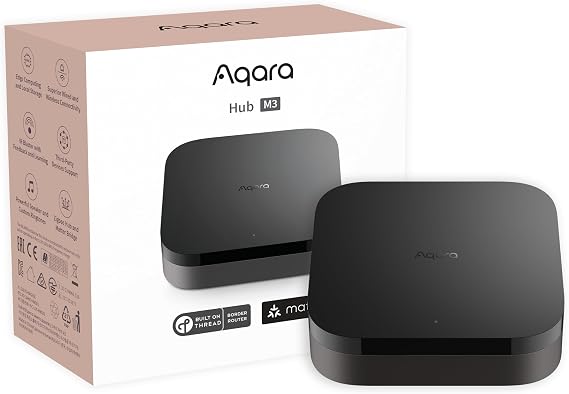
Aqara Smart Home Hub M3
Multi-protocol smart home hub supporting Zigbee, Thread, Matter controller and bridge capabilities, dual-band Wi-Fi, and Power over Ethernet (PoE) with local automation execution.
As an Amazon Associate, LifeMode earns from qualifying purchases.
8. Which Protocol Should You Choose?
The right choice depends on what you want to connect.
Choose Wi-Fi when:
- You want simple setup.
- The device needs a higher-bandwidth connection.
- You already have reliable router coverage.
- You do not want another hub for a small number of devices.
Choose Zigbee when:
- You are building a network of low-power sensors.
- You already own a compatible Zigbee hub.
- You want to use established smart home accessories.
- The products you need have confirmed hub compatibility.
Choose Thread when:
- You are buying newer low-power smart home devices.
- You want an IP-based mesh network.
- Your smart home ecosystem supports Thread.
- You have access to a compatible Thread Border Router.
Look for Matter when:
- You want better interoperability between supported ecosystems.
- You use products from multiple manufacturers.
- You want more flexibility when choosing a smart home platform.
- You want to reduce dependence on manufacturer-specific integrations.
9. Common Compatibility Mistakes
Assuming Zigbee and Thread are interchangeable
They are separate networking protocols. A hub must explicitly support the protocol used by the device.
Thinking Matter is a wireless network
Matter is an application-layer standard. It uses supported network technologies such as Wi-Fi, Ethernet, and Thread.
Assuming every Matter device works with every platform
Matter improves interoperability, but supported device types and features can still vary between ecosystems.
Buying a hub before checking device compatibility
A hub may support a protocol without supporting every device or advanced feature using that protocol.
Ignoring the existing network
Before expanding your smart home, check Wi-Fi coverage, router capacity, hub placement, and the availability of a Thread Border Router where required.
Final Thoughts
Wi-Fi, Zigbee, Thread, and Matter solve different parts of the smart home connectivity problem.
Wi-Fi provides familiar network connectivity. Zigbee and Thread offer low-power mesh networking. Matter helps compatible devices work across supported smart home ecosystems.
For a new installation, Matter and Thread support can provide useful flexibility. For an existing system, Zigbee may remain the most practical option.
The best approach is not necessarily to choose one protocol for everything. It is to select devices and hubs that work together reliably and support the features you actually need. Explore our Smart Home Hub for more practical guides and setup tips.